ERMIS Mission
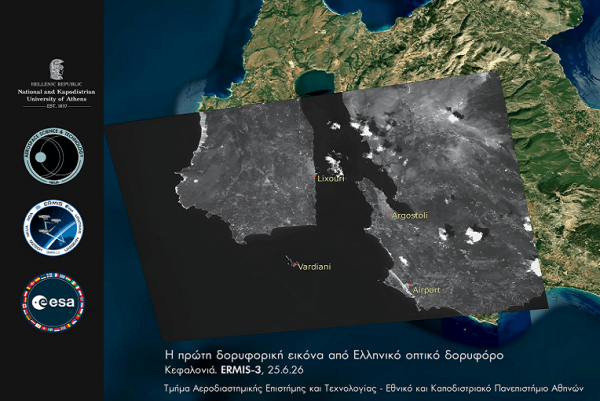
The ERMIS space mission made history by capturing the first Greek satellite image—taken by the first Greek nanosatellite, ERMIS-3—on June 25, 2026.
Greece is acquiring unprecedented "Made in Greece" space technologies and capabilities, as well as the ability to design, manufacture, and operate satellites for Earth observation and telecommunications. These serve national and European needs—such as civil protection, land registry management, smart agriculture, national security, defense, and citizen protection—while also supporting the education and research of students, researchers, and engineers.
The ERMIS space mission led to the development of new "Made in Greece" technologies and applications—constituting valuable national know-how—and unique research infrastructure at both national and European levels, established at the Department of Aerospace Science and Technology of the National and Kapodistrian University of Athens (NKUA) in Psachna, Evia.
As part of the ERMIS program, three highly technologically advanced nanosatellites (CubeSats) were built in Greece, focusing on 5G/IoT telecommunications, inter-satellite links, and Earth observation via hyperspectral remote sensing. They incorporate—for the first time—technologies developed entirely in Greece, such as: IoT/5G communications; inter-satellite links; in-orbit image data processing using hardware accelerators for hyperspectral image compression algorithms and optical channel coding compliant with CCSDS space standards; automatic control algorithms for monitoring and controlling the satellite's precise position; optical laser communications and a link between the satellite and the optical space ground station at Helmos; and hyperspectral remote sensing with 5m resolution for space applications of national interest, such as smart agriculture. These capabilities rank the three nanosatellites among the most technologically advanced satellites in the world today. It is worth noting that the three nanosatellites were designed, built, and launched simultaneously as a swarm—a feat no other university in the world has achieved.
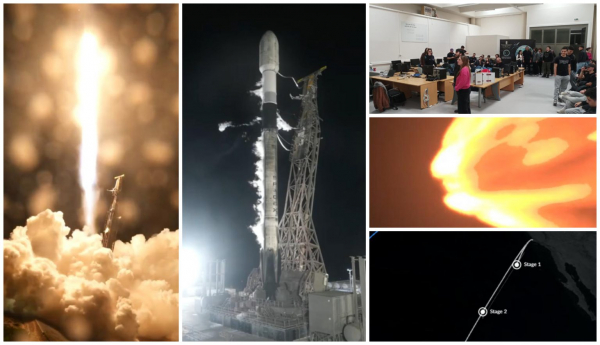 The three ERMIS 1-3 nanosatellites were launched on March 30 from California by SpaceX, using a reusable Falcon 9 rocket that had already flown into space twelve times. The Falcon 9 deployed the satellites into orbit at an altitude of 500 km, and within two hours, their initial signals reached the ground station located at the Department of Aerospace Science and Technology of the National and Kapodistrian University of Athens (NKUA). Three distinct tones confirmed that all three nanosatellites were healthy and operational, and were proceeding with the checkout of their subsystems and functions.
Beyond their innovative nature, a crucial aspect is the fact that these nanosatellites were designed and manufactured entirely in Greece through a unique consortium—a small "Greek National Team" comprising three universities (NKUA—Departments of Aerospace Science and Technology, Physics, and Informatics & Telecommunications; the University of Patras—Department of Mechanical Engineering and Aeronautics; and the University of the Aegean), the National Observatory of Athens, and the pioneering company OQ Hellas. The project was coordinated by lead scientists and professors Vaios Lappas and Antonis Paschalis of NKUA. The entire project was subject to rigorous technical and quality oversight by the European Space Agency. According to the mission’s chief engineer, Spyros Makris, "the level of technical and quality control was exceptionally strict and demanding, involving multiple large panels of engineers scrutinizing every detail of the satellites and the mission—a challenge the ERMIS team successfully met, as the final outcome demonstrates." The ERMIS program involved the design of a common Greek nanosatellite platform suitable for use in numerous future missions. This platform offers full access to the underlying subsystem and software technologies, enabling the ERMIS team in Greece to control and operate the satellites. As Professor Antonis Paschalis notes, "our satellites are truly 'Made in Greece'—from the screws to the very last line of code—providing us with significant strategic capabilities and national autonomy."
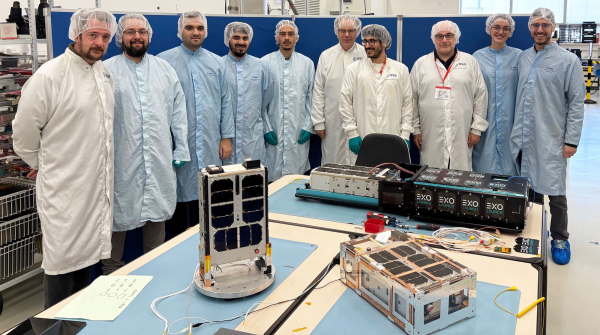
Group photo of members of the scientific team developing the ERMIS nanosatellites: Konstantinos Konstantinidis (OQ Technology), Sotirios Katsimpas (OQ Technology), Konstantinos Bouzoukis (University of Patras), Spyros Zervakos (NKUA), Panagiotis Tsitsas (AST, NKUA), Antonios Paschalis (Professor, DIT, NKUA), Spyros Makris (NKUA), Vaios Lappas (Professor, Chair of AST, NKUA), Zoe Genakou (OQ Technology), Georgios Tzanoulinos (NKUA)
The ERMIS 1 & 2 nanosatellites were designed and manufactured by OQH with the support of the National and Kapodistrian University of Athens (NKUA) and the ERMIS team, and were assembled at the NKUA’s Aerospace Department. They aim to transmit short messages via mobile phones, Internet of Things (IoT) devices, and 5G networks, enabling communication everywhere—even in areas lacking terrestrial cellular coverage. The pioneering company OQH is funded by the Phaistos 5G Venture Fund and is the only European company competing with SpaceX’s Starlink. OQH’s collaboration with Greek universities and organizations serves as significant proof that the Greek ecosystem is generating immense potential for growth and opportunity.
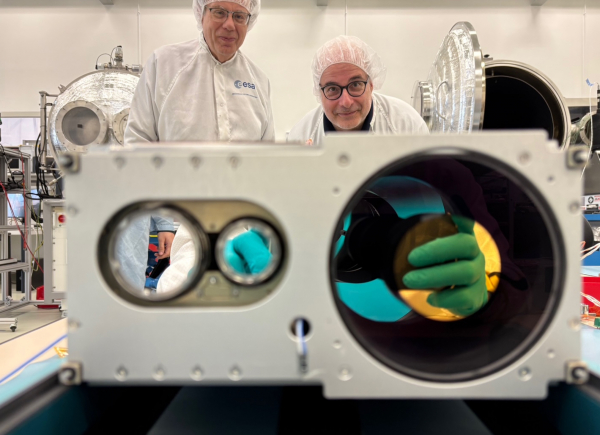
Professor Antonis Paschalis (Department of Informatics and Telecommunications, NKUA) and the Chair of the Department of Aerospace Science and Technology, Vaios Lappas, during optical certification testing
Along with EMRIS 1 and 2, ERMIS-3 ranks among the most technologically advanced nanosatellites in Europe. ERMIS-3 possesses Earth observation capabilities with a resolution/precision of 5 meters! Equipped with a 10-centimeter lens, ERMIS-3 captures images of any location on the planet across 30 different spectral bands (hyperspectral imaging), providing unique scientific and strategic data. The images are processed by the satellite's "brain"—a new Greek-made subsystem—where advanced artificial intelligence algorithms compress and process the data before transmission to Earth. As Professors N. Kranitis and A. Paschalis note, their team has developed and employs advanced algorithms that facilitate autonomous, secure, and rapid satellite data transfer. ERMIS-3 also features one of the first and most advanced lasers for optical telecommunications—a method considered the most secure in the world. In the coming days, the laser system will be tested in conjunction with the Aristarchos telescope on Mount Helmos; it has the potential to establish the most secure and fastest link ever achieved between space and Earth using a nanosatellite. Secure, high-speed laser communication links represent a critical strategic factor for national security and defense.
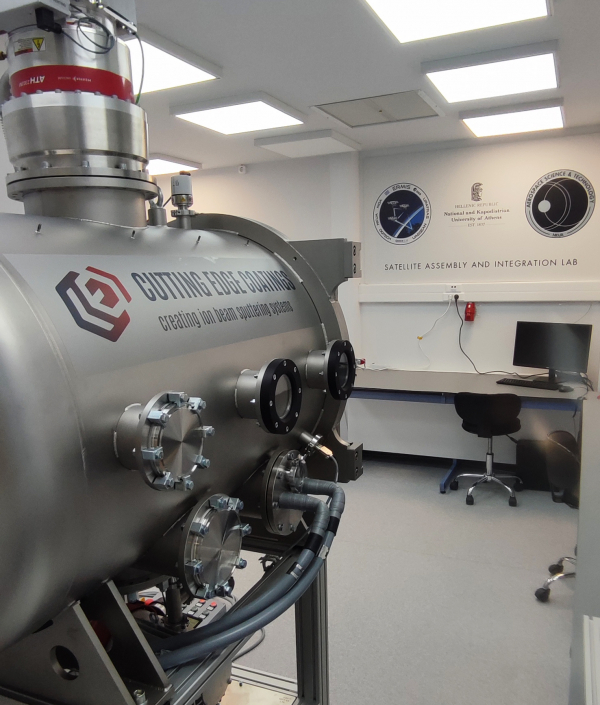
Clean Room
Through the ERMIS program, a comprehensive space center featuring unique national and European-level infrastructure has been established at the NKUA Department of Aerospace Science and Technology. This facility enables the end-to-end execution of satellite projects—spanning conceptualization and design, manufacturing, certification testing, and in-orbit operations—in collaboration with the industry. Notably, the nanosatellite assembly laboratory (clean room)—a complex, critical, and costly facility—was created with the sponsorship and support of BCT, a market leader specializing in the design and construction of specialized satellite facilities. This donation was pivotal, allowing the mission to be completed within the allocated timeframe and budget. In an adjacent area, the company EMTECH has contributed a specialized facility for satellite degaussing prior to launch. A fully equipped satellite operations and command-and-control center has been established; it is linked to a comprehensive ground station featuring S, VHF, and UHF band antennas, as well as a data center, and is already supporting multiple satellites and missions. According to Mr. Spyros Makris (Chief Engineer) and Assistant Professor Christos Tsigkanos of the Department of Aerospace Science and Technology (software.aerospace.uoa.gr), a fully autonomous and innovative satellite control system has been developed using artificial intelligence, enabling autonomous operation with a high degree of reliability and automation.
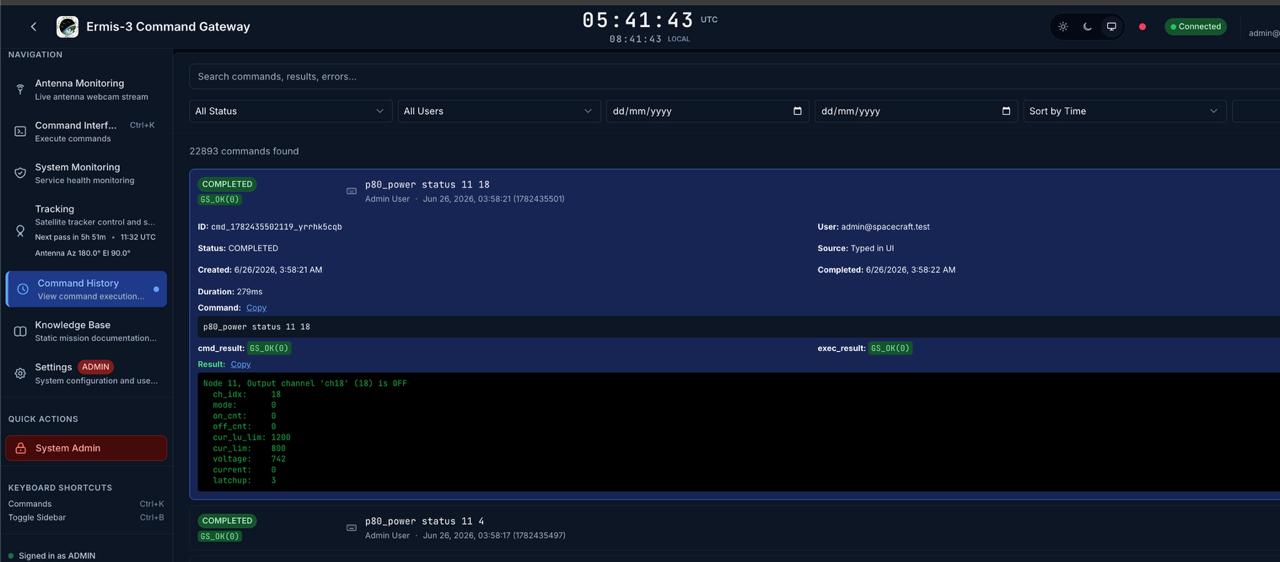
ERMIS Mission Control (Credit: Βίκτωρ Μπενετάτος, ERMIS Ground Systems Engineer)
Investment in state-of-the-art research and educational infrastructure—and, above all, in young researchers and students—through the ERMIS project has fostered significant technological and scientific capabilities in aerospace, satellite technologies, and satellite applications; these capabilities are unique within Greece and pioneering on a European level. According to Professor Vaios Lappas, the Department of Aerospace is already participating in eight space missions and has contributed to the construction of 14 of the 24 nano/microsatellites being built in the country. Beyond technologies and innovative applications, however, the ERMIS project has contributed to many vital areas, such as fostering collaboration among universities, research organizations, industry, and government ministries, promoting teamwork, and—most importantly—demonstrating that with a strategic plan, technological marvels can be achieved in our country within a very short timeframe, even amidst a highly competitive European landscape. The ERMIS program constitutes the first phase of the National Microsatellite Program, which has a budget of €200 million and is funded by the European Recovery and Resilience Facility (RRF – EU NextGenerationEU).
More information about the ERMIS research program and space mission: https://www.kathimerini.gr/society/563967040/apo-ta-psachna-eyvoias-sto-diastima/
The three nanosatellites of the ERMIS program were launched on Monday, March 30, aboard SpaceX's Falcon 9 rocket.